Just a quick hit of some videos that crossed my path this week.
First up, I feel every mood Robert has in this video.
May 19, 2024Join Robert for May’s Almost Breaking News! This episode tackles misinformation about electric vehicles spread by the BBC, busts myths surrounding secondhand EVs, and delves into the world of BIG electric trucks. Robert also explores Amazon’s extraordinary charging network, wooden wind turbines, the surge in EV chargers in the UK, gas leaks from old oil wells, the ongoing issue with Tesla and the Supercharger Network and some good news on Gigabatteries.Get ready for a whirlwind tour of all the essential news from the world of EVs and clean energy from the past month, peppered with Robert’s signature rants! @fullychargedshow @EverythingElectricShow
==========
A compilation of energy storage in rocks (mostly via heat) and its viability:
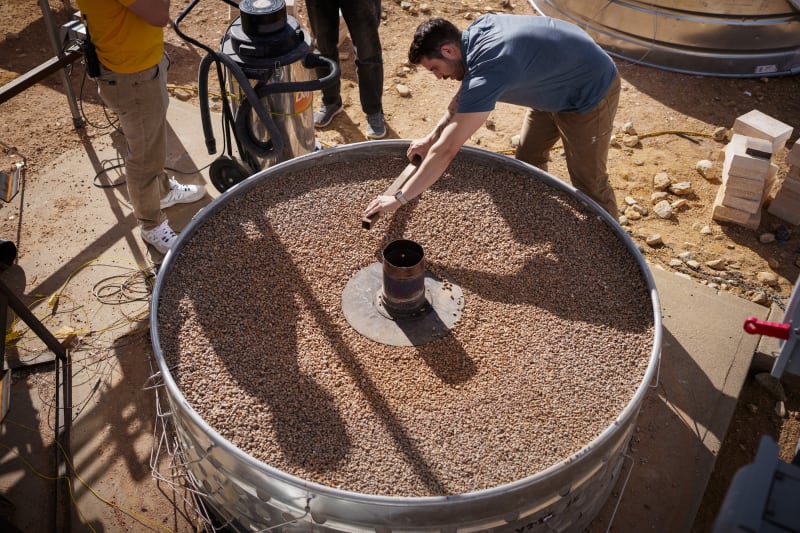
Sandia engineers convert excess renewable electricity into heat that gets stored in piles of gravel
Nathan Schroeder, a mechanical engineer at Sandia National Labs, arranges landscaping gravel in a thermal energy storage unit. Sandia is working with CSolPower on optimizing a low-cost solution for storing intermittent renewable energy. (Image: Craig Fritz, Sandia National Laboratories)
Storing energy is one of the key challenges for implementing sustainable but intermittent electricity sources like solar and wind. Engineers at Sandia National Laboratories are collaborating with New Mexico-based CSolPower LLC to develop a very affordable method of accomplishing that storage.
Thermal energy is very energy-dense — you can basically use any material that could withstand high temperatures to store heat and then deliver it when you need it. “Say you have a PV or a wind farm and you’re overproducing in the middle of the day. You can take that excess electricity and heat up air using a big resistive heater,” said Sandia engineer Luke McLaughlin. You can then use a blower to push the heated air through a bed of gravel, which is quite porous. That transfers the heat from the air to the rocks. You then close some valves, and the system goes into “hold” mode for hours, days, or weeks, until it needs to be released by reversing the flow. “The rocks have so much surface area, you’re blowing through what is basically a big sponge — it’s a lot of area for the heat transfer,” said Nathan Schroeder, a mechanical engineer at Sandia.
When the heat energy is ready to be used, it is transferred back to the air. The heated air can either be dispatched directly to a process or it can be used to create steam to drive a turbine like you would in a traditional power cycle. Read the rest here
=========
Two videos that talk about similar technology:
Oct 22, 2023Rondo Energy just secured $60 million of funding from some of the world’s shrewdest investors. So, can they now achieve their goal of a 90GWh per annum production facility for their simple heat battery technology, reducing global industrial CO2 emissions by 12 MILLION tonnes per year? Time will tell!
Jan 25, 2023How A Brick & Rock Battery Is Changing Energy Storage – Explained. The first 100 people to use code UNDECIDED at the link below will get 20% off of Incogni: https://incogni.com/undecided. Grid-scale lithium ion batteries are our current go-to chemical energy storage solution, but they present their own challenges in safety, sustainability, cost, and longevity. However, the competition is … heating up. New forms of thermal energy storage systems built using abundant, cheap materials are on the rise. One company is aiming to sidestep the complications that come with chemical batteries…with a brick battery. And another company’s weapon of choice is a crushed volcanic rock battery. Talk about going back to basics to store massive amounts of energy. But is simple really best?
==========
Once again the liberals are attacking your freedoms by suggesting it might be better to have healthier indoor air by using better technology. Cheesy fun with a great message:
May 22, 2024Faster, cleaner, safer, more precise, and more energy efficient, the induction stove is the stove of the future. And the future is now! ⚡️ Join us for Extraordinary Electrics as we put this top-of-the-line tech to the test and show you how induction cooking can make your life better. Did you know? Upgrading to energy-efficient electric appliances like an induction stove not only fights climate change — it also lowers your energy bills, improves air quality, and makes your home comfier. Win-win-win-win. Get started: https://www.rewiringamerica.org/newsl…


 Living Lightly